
Before sunrise in South India, the flower markets are already awake.
In Basavanagudi and Malleswaram, women in jewel-toned saris sit cross-legged beneath fluorescent lights threading jasmine buds into fragrant garlands while the city slowly gathers itself around them. The scent arrives first, rich, enveloping and unmistakable, drifting through temple streets, fruit stalls and humid morning air.
Madurai has long been synonymous with jasmine. So much so that in the 1970s, flights carrying baskets of Madurai malli to Chennai were nicknamed the “Malli Special,” with flowers often outnumbering passengers. Even today, the city seems to move through fragrance. Jasmine trails through temple corridors, market lanes and railway stations with such intensity that it feels less like scent and more like atmosphere.
India has always understood fragrance differently. Here, scent is not reserved for special occasions or bottled behind glass counters. It moves through everyday life. It lingers in prayer rooms, clings softly to silk saris and disappears into the braids of women returning home at dusk.
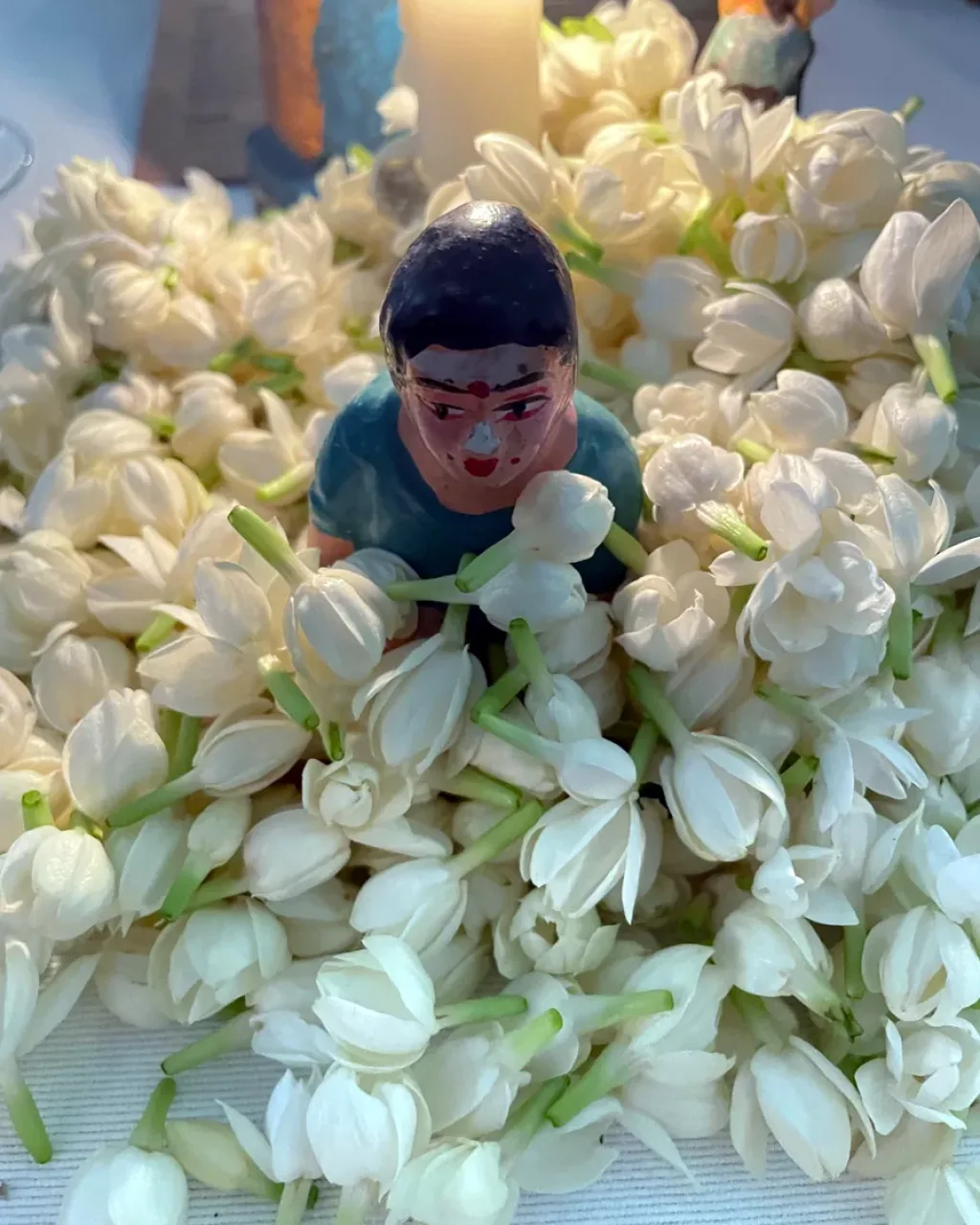
I had always loved jasmine instinctively, but it was only after spending time with my husband’s family in South India that I witnessed its rituals. Every morning began with fresh jasmine arriving at the house almost as routinely as the milkman or the newspaper. Tiny white buds threaded delicately by hand would appear at the door still cool from dawn, quietly perfuming the home through the day.
Some flowers would be offered during prayer. Others rested in bowls of water around the house. Others disappeared into the hair of the women in the family before breakfast had even begun. There was something deeply transporting about the repetition of it all. The way beauty existed not as occasion, but as routine.
Watching jasmine being threaded roadside feels almost hypnotic. Fingers move instinctively, conversations drift between gossip and silence, and all the while garlands continue taking shape strand by strand. The work is repetitive, but never mechanical. It feels devotional. Meditative even. It slows you down. So much of modern life moves aggressively towards speed and permanence. Jasmine offers neither. By morning the flowers begin to fade. Their beauty exists precisely because it is fleeting.
Meals rarely arrive alone. They are accompanied by fragrance, gesture and habit: sambrani rising through a room, jasmine woven into hair, a sari draped fold by fold, a kolam drawn across the threshold before the day begins. None of these announces itself as ritual. Together they simply become the rhythm of the day.
Long after leaving India, it is often jasmine that returns first. Not photographs or souvenirs, but scent. A single strand worn in the hair on a warm evening can collapse entire geographies, carrying with it the feeling of South India at dawn: fragrant, devotional and quietly alive.
Studio Priyanka grew from these observations. Cuisine was simply the way in.