Sign up to our weekly updates

E-Newsletter

Invalid email format
I agree to receive the newsletter and understand that I can unsubscribe at any time.
For more information, see our Privacy Policy.
img_1995.jpeg

Natasha Sachdeva: A Wrongly Framed Idea of Beauty

Author: Staff Writer

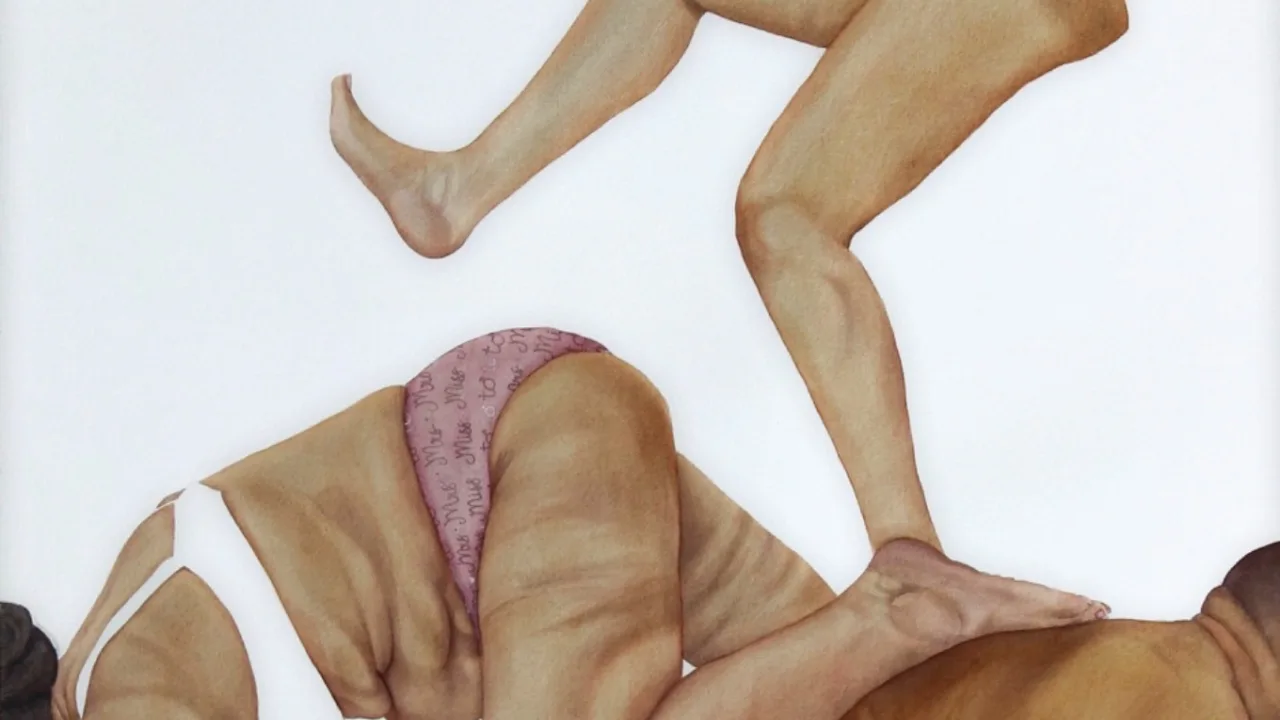
Natasha Sachdeva’s work explores themes like weight, ageing, marriage, and companionship. Through her unposed and often full-bodied figures, she questions the idea of beauty she grew up with and now sees as misguided.

Natasha Sachdeva, a contemporary artist from New Delhi, is known for her honest and deeply personal art. She draws on her own experiences, connecting them to broader social expectations.


For her first international solo show, Will This Entanglement Ever Resolve?, Sachdeva presented a series of intimate watercolours exploring the complexities of the female body and the realities of womanhood. After returning to India from Washington DC, she is now reflecting on her art and the world it comes from.
 

For Sachdeva, art is not a separate pursuit but an extension of being. “Art is a big part of my existence,” she says. “Whatever I see around me, including conversations, experiences, confessions, not just with others but with my own self and body, makes way into my art. Life keeps me inspired. It truly portrays the depth of human conditioning and how society functions around it.”

Her practice is rooted in an ongoing inquiry into womanhood. “As a woman in my early 30s, I have experienced how layered a woman’s life is,” she says. “My art gave me a way to explore and scratch these layers”. “I feel the life of a woman is not really hers,” she adds. “Through my art, I translate these influences and experiences into my paintings. I want to embrace this side of womanhood which one refrains from.”


Much of this perspective is shaped by her upbringing. “The experiences, conversations, conditioning and upbringing together have completely shaped me into the person I am today,” she reflects. Growing up in an upper middle-class household, she was acutely aware of how gender roles were reinforced from an early age. “The idea that the role of genders plays a major role in how we function as a family was reinforced to me since I was a little girl,” she says, describing expectations of women as nurturers and givers, often at the cost of their own desires. It was only later that she recognised that the repeated statements used at home, “you are the daughter of the house; you cannot go out late at night. Serve the men of the family first” as “a transfer of insecurities, patriarchy and generational trauma.” “It made me believe that these words were actually true,” she says.

That conditioning extended to the body as well. As a teenager, a sudden weight gain and the reactions it drew left a lasting impact – a wrongly framed idea of beauty.

That conditioning extended to the body as well. As a teenager, a sudden weight gain and the reactions it drew left a lasting impact – a wrongly framed idea of beauty. “I developed a very unpleasant relationship with my body,” she recalls. “I started looking up to females who were in the ‘perfect’ body shape. I began to think of the body only in terms of its physicality.” It would take years to unlearn this. “It’s not about the weight that can be seen,” she says now. “It’s more about the weight that exists but cannot be seen or touched.”

One piece she repeatedly returns to is her own Thanks! No More P**Y For Me. “This work was my reaction to how deeply and silently patriarchy is rooted in our society,” she explains. The self-portrait depicts a man as both lover and oppressor. Holding her hands on one side while attempting to dominate her on the other. “The idea was to show how patriarchy is often disguised as love, care and concern,” she says. “Women, being the giver, believe it so deeply that they fall into this trap and live their entire lives losing themselves.”


Even though her themes are emotionally heavy, Sachdeva relies on discipline to keep going. Being a full-time artist without a regular job’s structure takes a different kind of commitment. “There’s a void and a sense of hollowness that keeps piling up in me if I don’t create art,” she says. “The core desire to give life to my thoughts and ideas has always kept me going.”


Sachdeva’s connection to culture goes beyond her studio. She often visits places like Dastkar and Dilli Haat to stay in touch with India’s diverse traditions. She also values conversations with women from different backgrounds. Talking about her house help, who married young and has three children, Sachdeva points out how different life timelines affect women. “If a woman doesn’t meet that timeline, she’s often considered behind in the rat race,” she says.


Sachdeva is equally open about the challenges in the art world. She says it’s a misconception that the field is still male-dominated, as more women artists and curators are being recognised. However, she also notes that non-traditional art faces limits. “Art that is easily understood and appealing to the eye is more acceptable,” she says. “The kind of work I make is bold. It makes viewers uncomfortable, and because of that, I get fewer opportunities.”in the United States becomes particularly significant. Selected through an open call, her solo exhibition with nonprofit organisation International Art & Artists at Hillyer in Washington DC marked a major milestone. But beyond the professional achievement, it was the cultural encounter that left a deeper impression.

“My visit to the US has brought about a shift in the way I view my art,” she says. “The cultural shift I experienced between my country and the US is huge and deeply impacted me.”


During her fifteen days in the US, Sachdeva spent time observing women of different ages and backgrounds. “The way they were dressed, their body language, expressions, and reaction to the male gaze,” she says. She noticed these things everywhere, from the streets to high-end stores, and from service workers to museum visitors. Her conversations with women viewers stood out to her. “Their take on how they look at their bodies and life in general was an interesting layer,” she reflects.


Now that she is back in India, Sachdeva is most excited about what comes next. “I have carried along with me a whole lot of information to process and reflect upon,” she says. “I’m most excited about how this knowledge and experience will translate into my art.”


For Sachdeva, nothing stays outside for long. Memories, observations, and even discomfort all eventually become part of her art.

Shopping cart

Loading cart...
Your cart is empty

Subtotal

Shipping and taxes calculated at checkout.