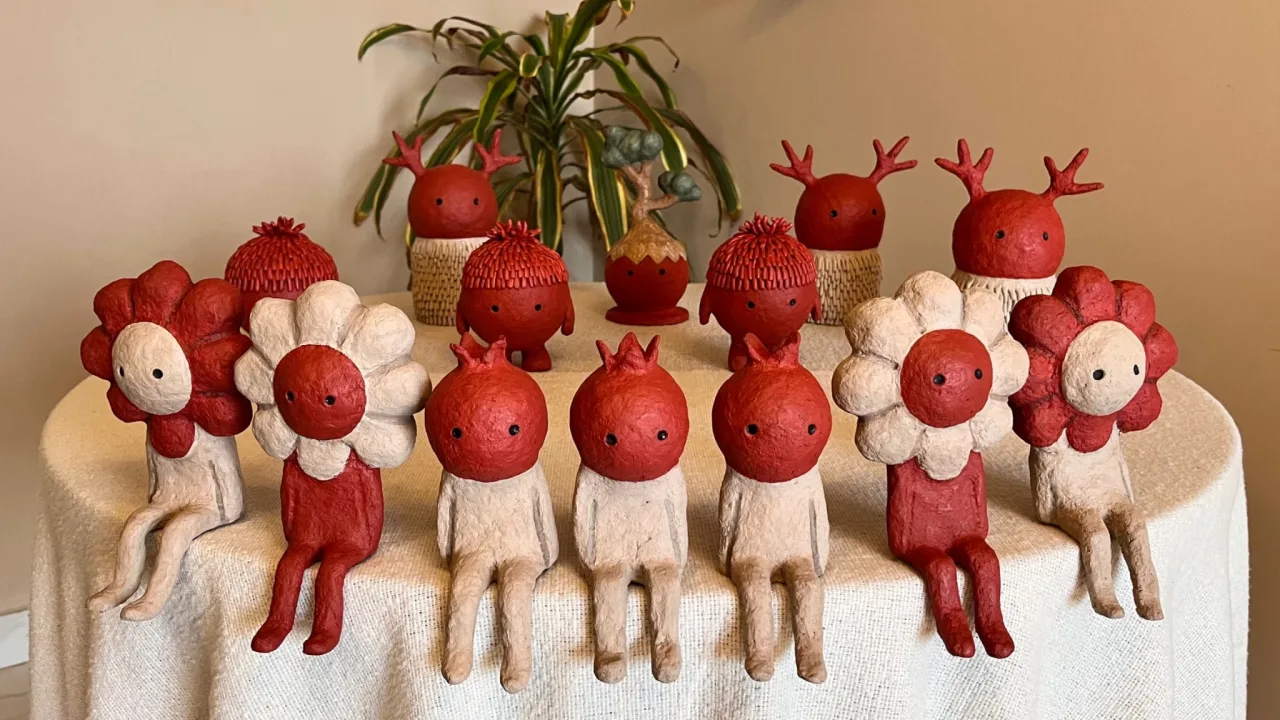
Mumbai-based artist Tanaya Sharma's work occupies a world somewhere between nature, imagination and storytelling. Working across illustration, painting and sculpture, she has developed a distinctive visual language of earthy textures, organic forms and curious beings. Most recently, that language has taken shape through Morom, her growing family of handmade papier-mâché creatures.
Sharma’s aesthetic is instinctive rather than deliberately constructed. “The colours, shapes and textures that I see in nature stay somewhere within me, long after I've seen them,” she says. “Nature is where I return to, and my imagination grows from there.” It is a sensibility that runs through everything she makes. Whether painting, sculpting or imagining a new character, Sharma says her work always seems to return to the same visual language, “as though it has all come from one place.”
For the Morom family, that place begins with something deceptively simple: a circle, inspired by the silhouette of a pomegranate. From this basic form, Sharma begins to imagine and sketch each character before moving into sculpture. The sketch, she explains, is where she gets to know them, to understand their form and imagine who they might become.
In her imagination, the creatures are little protectors of the forest, each with their own personality, quirks and way of being. Although they all emerge from the same source, no two are quite alike. That individuality is heightened by the handmade nature of the work. Their surfaces are uneven, wrinkled and textured; nothing is overly polished or engineered. For Sharma, this is not an imperfection to be corrected but an essential part of the work.
“I love how my beings look like they are born from earth itself,” she says. “Earthy, uneven surfaces and textures, wrinkles, make them feel more alive to me.” For Sharma, there is something fundamental in that imperfection. “Nature was never really interested in perfection, only in becoming,” she says. “That idea inspires me deeply.”
Sharma wants to make things with her hands as long as her body will let her. “Something that didn't exist before, but now has a place in my world,” she says. Perhaps this is why the Morom creatures feel less like objects than companions. Sharma imagines them existing somewhere between imagination and reality. They are not intended to have a fixed meaning or a single interpretation. “I think that's why it matters to me that they don't have to explain themselves,” she says. “They can simply exist.” That sense of freedom becomes particularly important when one of the beings leaves the studio.
She hopes they carry something with them into their new homes — comfort, joy or affection. And when owners give them names of their own, she welcomes it. “Once they leave me, they become a little part of someone else's world. I don't want to control how someone sees them or what they mean to them. I think they should have a life beyond me.”
The Morom family is still growing, and Sharma sees no obvious end to the world she has begun to create. She imagines a home where all of the beings exist together, slowly taking shape “one being, one story, one little piece at a time.” It is a world she wants to continue building for as long as she can.
“Imagination is how I survive, how I feel, how I stay,” Sharma says. “I don't create these beings to escape reality. I create to belong to it, to live with them.”